We respect your privacy






















Increase in unwanted messages and fake inquiries
There has been an increase in the number of inquiries that hosts, like you, receive to their email addresses or through contact forms on their websites. This may be a sign of increased interest in your services, but also something to which you should pay special attention.
We have identified several types of messages that often repeat:
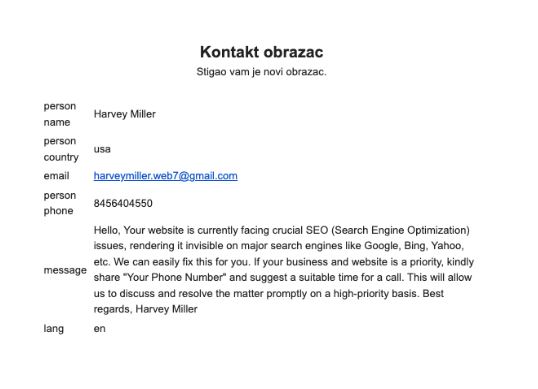
- Warnings about poor SEO on your website, accompanied by offers to improve it.
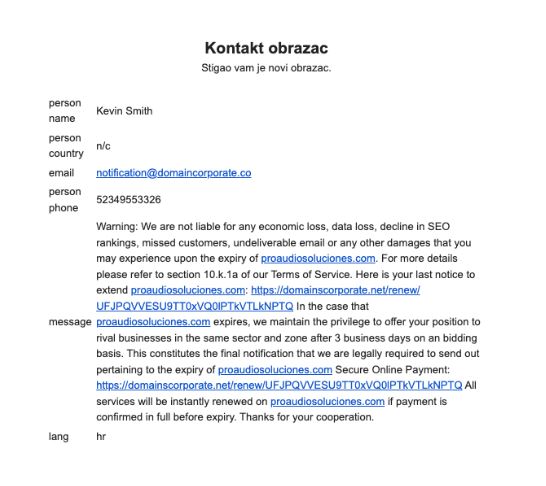
- Notifications about domain expiration, which also contain links for supposedly urgent payment of renewal.
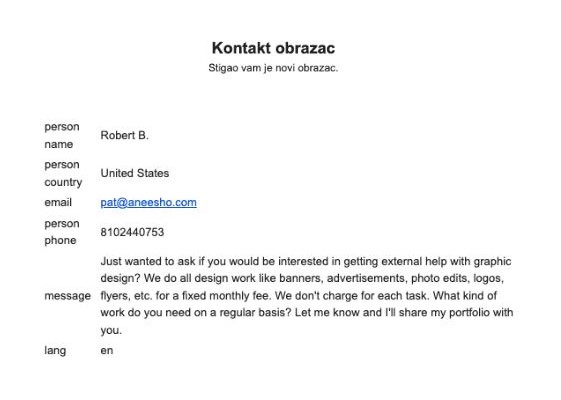
- Offers for graphic design solutions for your brand and requests for further contact.
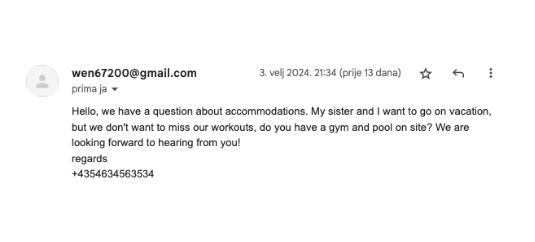
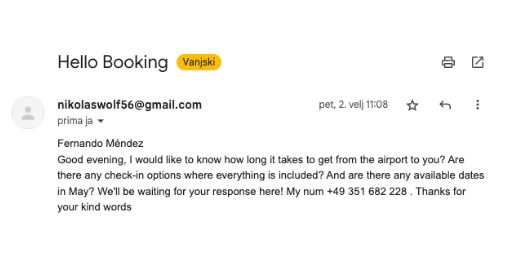
- Inquiries specific to your property, such as distance to certain points, equipment, and availability.
Below we present several examples of this type of communication:
How to recognize phishing messages?
If you have received similar messages, know that this is phishing, that is, an attempted scam. Scammers use email addresses and contact forms on websites to mass-send fake offers. Although in rare cases there may be a real person behind such messages, most often they are automated bots.
- Generic names of senders, often inconsistent with the stated location from distant parts of the world. In our examples, certain senders even repeat, such as Harvey Miller and Kevin Smith.
- Unusual requests such as asking for a phone number even though it is already on your site, or questions about availability and number of guests, even though you have clearly stated and updated all this information on your pages.
- Offers to renew a domain that does not belong to you at all.
Why are you receiving such messages?
The fact that you have a contact form or a published email address on your website is necessary for your business to function, but at the same time it makes you vulnerable to these kinds of scam attempts. Scammers exploit the availability of this information and send mass emails, some of which are legitimate, some obvious spam, and some sophisticated phishing attempts that are difficult to distinguish from authentic messages.
Interestingly, even we, despite not being involved in renting real estate, received similar inquiries about “our property.” This further confirms that these are automated messages or spam.
How should you react to phishing?
Simply receiving a phishing message does not in itself represent a risk. However, scammers will try to collect additional contact data and misuse it for malicious purposes. Therefore, we advise you to:
- Do not reply to phishing messages and do not continue communication with the sender.
- Do not click on links in such messages.
- Never share private data, especially information about your credit card.
For more information or assistance, feel free to contact us. Your trust means a lot to us, and we are grateful for it.
If you need a service outside our offer, but one that is mentioned in one of the phishing emails, we advise you to contact a verified company.
We wish you successful business and safe communication with your clients!